Wikimania 2026 Team Challenges: experience report
Table of Contents
At this year’s Wikimania (the annual conference of the Wikimedia movement), a new sub-event was introduced: the Team Challenges. This post summarizes my experience of it as a participant.
Traditionally, the Wikimania hosts a rather loosely structured “hackathon”, which mostly consists in making a big room available for people who want to hack on things throughout the conference. There is an opening ceremony for it, where participants are able to pitch the projects they intend to work on, and a closing ceremony where they present what they did.
This works well for folks who know what to work on and how. It is also a generally quiet place where I can get a quick break from more social activities happening in the rest of the conference. But it’s clearly not for newcomers: you need to know what to do. The people around you are all staring at their screens and doing their things: if you don’t know them yet, it’s not so easy to break the ice or ask for help.
The Team Challenges offered a very welcome alternative to this format. We signed up to participate a few months ahead of the conference, stating our prior experience, areas of interest and languages spoken. Based on those sign-ups, the organizers assigned us to teams, where we had different roles:
- participant, not necessarily familiar with the Wikimedia tech ecosystem but wanting to get involved
- mentor, with prior experience of building things for Wikimedia projects, available to support their team members to build something together
- super-mentor, someone with deep knowledge of a specific domain, who can be reached out to by anyone in the event (not just from their team)
- coach: the organizers invited coaches from EMCC (or rather its French branch) to facilitate the work in teams
In my team, there were one coach, one super-mentor, one mentor (myself) and five other participants. A few of them I knew to various degrees from various online and in-person interactions. More infos about the structure of the event can be found on the event website. I’ll focus on my own impressions and lessons learned.
Helping newcomers get started with tool development for Wikimedia #
This format felt very appropriate to help people get started in the Wikimedia tech spheres. The focus was on team work, not on just building a prototype as fast as possible. The participants were coming from more diverse horizons than what we generally experience at the hackathon.
Of course, there is a big question mark as to what the participants do with this experience after the end of the event: are they going to continue this sort of work? Do they have the confidence, time and knowledge to do so outside of the supportive structure of the event? I expect it to be rarely the case, but that’s true of most events organized around the onboarding of new members in a community: there is necessarily a significant proportion of drop-outs. Also, even if they don’t stay, they might still have got something out of it that can be useful in other contexts.
Helping old timers get better at mentoring #
When I signed up for the event, I did so somewhat reluctantly because the format of the event was a bit daunting. By signing up as a mentor, I was hoping I’ll just be asked some questions from time to time, such as how to deploy a tool as a gadget or on toolforge, or help people navigate the different possibilities to consume data from Wikidata.
In the first phase of the challenges, happening online, I was quickly thrown into what felt like a much different role: scheduling and facilitating our first online meeting and trying to find a process to identify a common project for us to work on. It felt quite a bit more managerial that I was expecting, and also required more time than I expected ahead of the event. But it was definitely good training!
Working with a coach #
When the organizers told the mentors they invited some coaches to participate, there were mixed reactions in the advisory group around the event. Someone mentioned having had bad experiences with coaches. Involving coaches who had no prior exposure to the Wikimedia movement looked perhaps a bit risky.
In our team, it felt like a positive experience to me. The presence of our coach Aurélie felt really useful to me, especially in the first online phase where we were all a bit lost as to what to work on and how to get to know each other. The separation between my mentor role and her coach role was a bit unclear to me, because from the organizers' communication I had the impression that I was expected to take the lead and facilitate the team-building more than her, but I asked for her help with those initial meetings and it worked out well enough, I would say.
Having someone on the team with minimal prior exposure to Wikimedia meant that we sometimes had to make some things more explicit and quickly explain some terms, but that wasn’t a big hindrance and probably helped create a climate where it was okay to ask about basic things.
So I’m really glad they took this initiative.
Communication with the organizers #
The communication ahead of the beginning of the online phase was somewhat sparse and I was overall a bit confused about what sort of work we were expected to do before the in-person event. I was a bit stressed about our team being able to deliver something by the end. Because this was a brand new format, it was particularly challenging for the organizers since we couldn’t rely on prior experience.
It also felt a bit difficult to have to have to adapt to changes in the team composition, which happened multiple times after the start of the first phase. It was time-consuming and perhaps somewhat detrimental to the team spirit to have to onboard latecomers after the fact.
But those were minor annoyances - I am really happy that the organizers tried out this new format, which was a success in my opinion. I’m also quite proud of our team and had a great time. I hope to see this format in other events in the future, be it within Wikimedia or in other contexts.
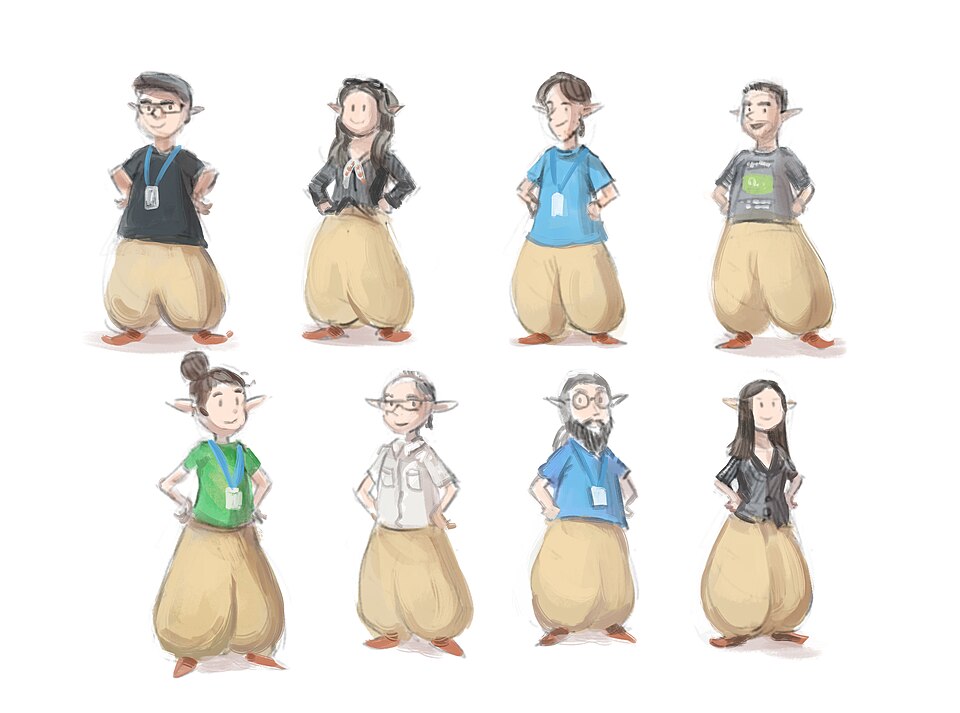
I’ll leave you with this sketch of our group by David Revoy, who was part of the team! We are represented in the style of the “Zéfirottes” creatures, magical creatures invented by Claude Ponti, after which our team was named.